
Monarch Rest Mattresses: An Honest Look at How They Compare
I’ll level with you about mattress shopping. Most of the numbers stores put in front of you are the wrong ones. You’ll hear about coil counts and “gel-infused this” and “proprietary that,” and almost none of it tells you the thing you actually want to know, which is whether you’ll still be sleeping well on this mattress in ten years or whether you’ll be back in a showroom long before that.
I spend a fair amount of time talking with people who are trying to make sense of all this, and the same handful of details come up every time. So instead of selling you anything, I want to walk you through what genuinely matters, wire gauge, foam density, the layers you never see, edge support, and warranty terms. I’ll show you where Monarch Rest lands on each, and I’ll give it to you straight, the real specs, not a sales pitch, so you can see the difference for yourself.
Let me tell you why I care so much about what’s inside a mattress. Years ago, my wife and I bought one of those beds you’ve seen advertised a hundred times, the wine glass that won’t tip, the egg that survives a dropped weight. It wasn’t cheap, and for a while it did the job. But it didn’t last anywhere near as long as we’d been promised. Seven years in, we were shopping again.
And here’s the thing that still bugs me: I had no idea what had actually gone wrong, or what to look for in the next one. So we went back to the same place and got sold a “comparable” model, and it turned out to be anything but. Within a few years it had a permanent dent right where I sleep. The edges had gone soft, so I’d roll toward the middle all night. And I could feel the harder layers pushing up through the top, right into my hips and shoulders. I was buying an expensive mattress twice and still waking up sore, because I couldn’t tell a well-built bed from a good sales pitch.
I can now. Learning how these things are actually put together, the wire, the foam, the layers you never see, showed me that almost everything that went wrong for us was baked in from the start, and avoidable. So when someone asks me what makes a mattress last, I don’t start with the commercial. I start with what’s inside it.
Wire gauge, the number that fools almost everybody
Here’s a question I like to ask: which lasts longer, a mattress with 1,000 coils or one with 450?
Most people guess the 1,000. It feels right. More is more. But coil count alone doesn’t tell you much, because it says nothing about how much steel is in each coil. That’s what wire gauge measures, and the scale runs backward from what you’d expect. A lower number means thicker, stronger wire. So a 12.75 gauge coil is meaningfully heavier-duty than a 14.5 gauge one, and thinner wire is exactly what lets a manufacturer cram in a higher coil count for the spec sheet.
Monarch Rest uses 12.75 to 13 gauge wire in its innerspring lines, which include Elite, Quiet Night, and Perfect Choice. The typical industry standard sits around 14.5. It’s heavier steel, chosen for how long it holds up rather than for a bigger number to advertise.
Foam density versus firmness, and why your old mattress got that dent
This is the distinction I wish every shopper knew, because it explains the most common complaint I hear: the permanent, you-shaped dent that shows up a few years in and starts wrecking your back.
Firmness and density are two different things, and people mix them up constantly. Firmness is just how the foam feels when you lie down, soft or medium or firm. Density is how much the foam actually weighs per cubic foot, and that’s the part that decides how long it lasts. You can have firm foam that’s low density, and it’ll feel supportive at first and then give out fast. You can have plush foam that’s high density, and it’ll feel soft for years without caving in. They’re independent.
That dent in your old mattress was almost always low-density comfort foam wearing out. The lighter foams, often in the 1.2 to 1.5 pound range, cost less and feel perfectly nice on the showroom floor. As a rule, though, they start showing impressions sooner.
Monarch Rest runs 1.8 pound density foam or heavier as its standard, and steps up to 2.4 pound foam in the high-wear areas of its premium lines like Integrity, Perfect Choice, and Resilience. The foam-core and gel models, such as Conforma, use 4 pound gel-infused memory foam, which is the high-density tier you’d associate with the better memory-foam beds.
The layers nobody shows you
Between the comfort foam and the springs, a well-built mattress has insulation layers, things like a polyester pad, a resonated pad, protective mesh, and a mid-section support pad. They’re easy to skip because you can’t see them, but without them the comfort foam slowly gets pushed down into the coils, and that’s what breaks the foam down and creates impressions. Monarch Rest has spent more than 30 years dialing in those layers so the foam and the springs aren’t fighting each other.
A test you can do standing in the store
Here’s a free one. Sit on the very edge of the mattress, the way you would to tie your shoes. If it collapses under you or you feel like you’re about to slide off, that’s weak edge support, and it means you’ll lose usable sleeping space and watch the perimeter sag over time.
Edge support gets done a couple of ways. Some mattresses use foam rails, which are lighter and cheaper and compress faster. Others use reinforced border coils, which hold up better to years of sitting and climbing in and out. Monarch Rest uses double-edge coil supports on most of its models.
Reading a warranty without falling asleep
A warranty tells you how confident a company is that its mattress will last, so it’s worth a real look. Four things matter more than the headline number of years. First, the body-impression threshold, which is how deep the sagging has to get before a claim counts. Lower is friendlier to you, because a half-inch dip is already enough to bug your back. Second, whether the warranty insists on the company’s own foundation or accepts any proper support. Third, whether coverage is full or prorated, meaning you start paying a share as it ages. And fourth, who covers shipping, which is usually you.
I pulled the current published terms for several well-known brands so you can see them side by side. These are accurate as of 2026, and since companies do change them, it’s always worth confirming directly before you buy.
| Brand | Warranty length (as of 2026) | Impression depth needed to make a claim |
|---|---|---|
| Monarch Rest | 20-year limited (first 10 full, next 10 prorated) | 0.5″ |
| Tempur-Pedic | 10-year limited | 0.75″ |
| Purple | 10-year limited | 1″ |
| Sealy | 10-year limited | 1.5″ quilted / 0.75″ flat non-quilted top |
| Serta | 10-year limited (most models) | 1.5″ quilted / 0.75″ smooth top |
Two things stand out. The first is the length. Monarch Rest covers you for 20 years, twice the 10-year coverage that’s typical. And here’s the part worth sitting with: 20 years isn’t a low bar dressed up to sound generous, it’s about the entire realistic life of a quality mattress. Sleep researchers generally put a mattress’s useful life at 7 to 10 years, and even the best-built ones have a finite lifespan. No mattress lasts forever. Past a certain point the support fades and hygiene catches up with it, no matter how it looks on the surface. So a 20-year warranty already runs well beyond when most people replace a mattress, and it stands behind a premium one for essentially as long as you’d actually want to sleep on it. Coverage that stretches past that is more theoretical than practical, because nobody should be on the same bed for three or four decades.
The second thing is that impression threshold. At a half inch, a Monarch Rest claim qualifies with less sagging than the three-quarter-inch to inch-and-a-half thresholds you’ll find elsewhere, which means the coverage kicks in right around the point you’d actually start to feel it. The terms themselves are refreshingly plain: for the first 10 years, they repair or replace for free for defects or impressions over half an inch, and you just pay shipping. For years 11 through 20, it’s the same coverage at 50 percent off, with impressions needing to top an inch.
What it really costs, looked at honestly
Everybody asks why a quality mattress costs more up front, and the fair answer is that sticker price isn’t the number that matters. What matters is cost per year of good sleep. A mattress that holds its support twice as long can end up cheaper over its life even if it cost more at the register, simply because you’re not replacing it as often. So when you compare options, ask how long each one is realistically built to last, look at the warranty terms above, and do the math on the years rather than the day-one price. I’m not telling you the priciest option always wins. I’m saying you’ll make a better decision comparing the right number.
How these actually get made
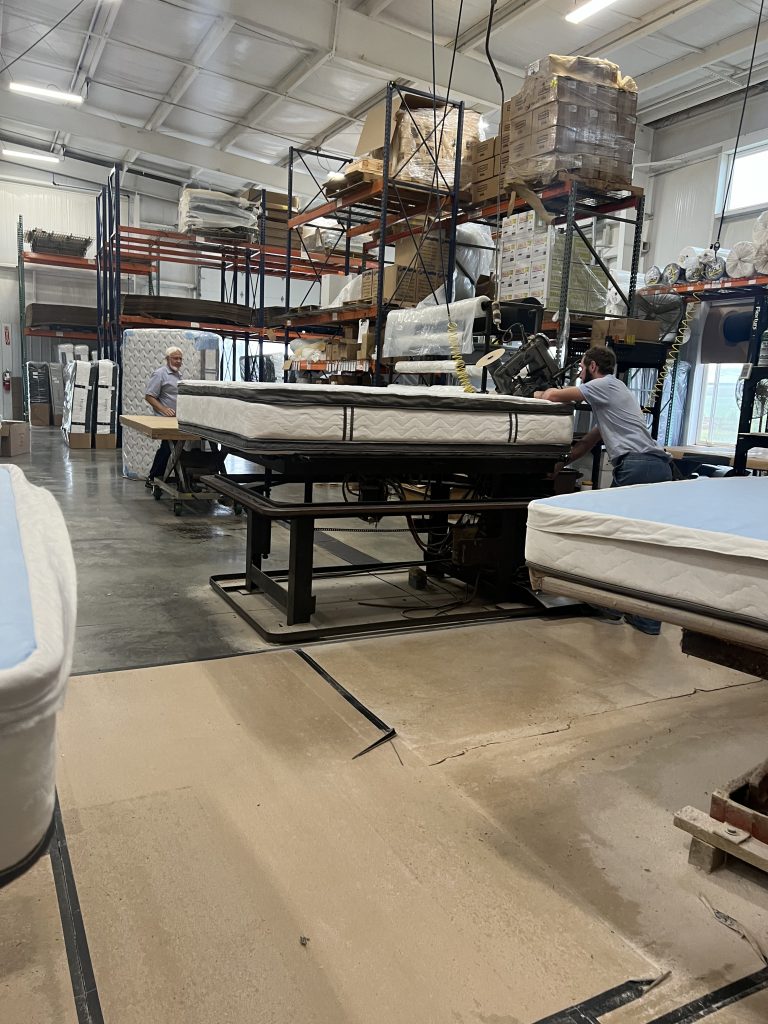
A mattress is shaped as much by how it’s built as by what goes into it. Monarch Rest mattresses are hand-assembled by a small team in Sugarcreek, Ohio, and they’re made to order rather than run down a high-volume line, so each one gets individual attention. Because they’re built to order, custom sizing is on the table too, which matters if you’ve got an antique bed, an RV, or some other oddball dimension.
One detail you’ll never see on a spec sheet: they bond the foam layers with water-based glue. It costs more and takes more skill than the spray adhesives a lot of factories use, but it makes for stronger bonds and helps keep the layers from separating down the road. That’s the kind of choice that pays off at year fifteen, not on the showroom floor.
A few honest things to know going in
I won’t pretend a Monarch Rest is the instant-gratification option, and I’d rather you hear it from me than be surprised. Because every one is built to order, you won’t walk out of the store with it the same day, so if you need a bed for tonight, plan around that. And you buy it through a dealer rather than as a box that shows up at your door, which to me is a feature: you get to lie on the actual mattress and ask real questions before you commit, instead of guessing and hoping. You may also not recognize the name the way you would a brand that spends heavily on national advertising. That’s by design. The money goes into the steel, the foam, and the people building it, not the commercials. None of that changes what’s inside the mattress, which is the part that decides how you sleep on it ten years from now.
The questions worth asking anyone
Whether you end up looking at Monarch Rest or anybody else, a few questions cut through the marketing fast. On construction, ask what gauge the innerspring wire is (lower is heavier, 13 or below is robust), what the foam density is in pounds per cubic foot (1.8 is good, 2.4 is excellent), how many insulation layers sit between the foam and the coils, and what kind of edge support it has. On the warranty, ask what impression depth qualifies for a claim, whether you’re locked into their foundation, and whether shipping is covered. And on value, ask how long it’s expected to last and whether custom sizing is available. If a salesperson can’t or won’t answer those, that tells you plenty on its own.
The short version
Most of what decides whether a mattress lasts comes down to a few plain realities, not advertising. Heavier wire resists fatigue longer than thin wire. Denser foam resists impressions longer than light foam. Proper insulation keeps the comfort layers from breaking down into the coils. Strong edges protect your sleeping space. And a warranty with a low impression threshold is one you can actually use when the time comes.
Here’s what I’ve learned after years around this: it’s easy to get one or two of those right. The hard part, and the rare part, is getting all five right in the same mattress, because the corners that get cut are the ones you can’t see on the showroom floor. That’s exactly where Monarch Rest separates itself. Heavier-gauge steel, high-density foam, real insulation layers, reinforced edges, hand assembly in Ohio, and a 20-year warranty that starts protecting you at a half-inch dip. Not a strong spec sheet with a weak link buried in it, the whole list, every line. That’s the difference between a mattress you’re still sleeping well on in fifteen years and one you replaced twice in the meantime, like I did before I knew what to look for. Now you know what to look for too.
If you want to feel the difference for yourself, that’s the best way to settle it, and we’re glad to walk you through the lineup at Millwest. You can see the collection here: Shop Monarch Rest mattresses. If you’d rather read first, our buyer’s guide helps you match a series to how you sleep, and our piece on what makes a mattress last digs into the construction side.
Steve Payne is the Digital Marketing Specialist at Millwest Amish Furniture in Plain City, Ohio. He writes about solid wood craftsmanship, furniture care, mattress selection, and the materials that make Amish-built furniture last for generations. With deep roots in Ohio’s furniture community and direct access to Millwest’s network of Amish craftsmen, Steve brings a practical, experience-driven perspective to every article.