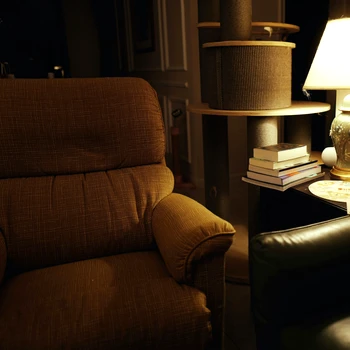
Everyone is familiar with the classic recliner in the living room. Dad’s chair he would sit in at the end of a hard day of work. He’d plop down, crank the handle on the side and his feet would spring up as he settled in for his favorite tv show or to read the paper. For a long time, this was the standard of recliners. But welcome to the 21st century, where options abound! Today there are multiple kinds of recliners to choose from, and this article will walk you through them.
Every recliner does the same basic job. The back goes down, and in most cases the feet come up. What separates the different types of recliners is how they get you there and what the base of the chair does while you sit. Some recline with a push, some with a button. Some sit still, while others swivel and glide. Once you know those two things, the whole category gets a lot easier to shop.
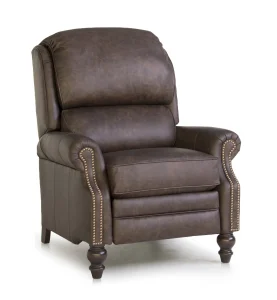 Of all the types of recliners, the pressback is the closest cousin to Dad’s chair, minus the handle on the side. There’s no lever at all. You sit back, press gently with your shoulders and arms, and the chair reclines as the footrest rises. To come back up, you lean forward and push the footrest down with your calves. With no handle, a pressback keeps a clean, tailored look that’s easy to mistake for a regular upholstered chair. It also needs no cord or outlet, so you can put it anywhere in the room. The trade-off is effort. It takes a little body weight and leverage to work, which some folks love and others find a chore. You’ll also want some open floor behind it, since the back swings rearward as it reclines. Smith Brothers Style 705 is a good example, available as a pressback in fabric or leather.
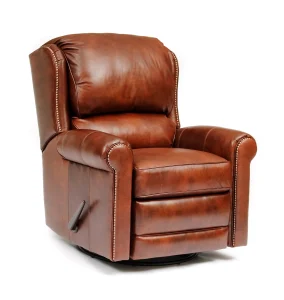 A power recliner, which Smith Brothers calls motorized, swaps your muscle for a motor and a button. Press and hold, and the chair moves smoothly. Let go, and it stops right where you are. That means you aren’t limited to sitting up or lying all the way back. You can stop at any angle in between, perfect for reading or a quick nap. Some power models even add a motorized headrest, so you can tip your head up to see the TV while the rest of you stays reclined. Power is also the easy choice for anyone who struggles to push back a manual chair or close the footrest. On the other hand, a power recliner needs to sit near an outlet, it costs more than a manual chair, and it has more working parts than a simple mechanism. Styles 705 and 720 both come in a motorized version.
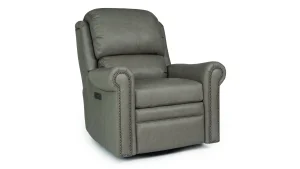 The swivel glider recliner does three things at once. It turns a full circle on its base, it glides gently back and forth, and it reclines. The glide is a smooth, level motion rather than the rock of curved runners, so it feels calm instead of tippy. That’s why you’ll find so many of these in nurseries, where a slow glide is a parent’s best friend at 2 a.m. They also shine in open floor plans. Swivel toward the TV for the movie, then turn toward the kitchen to join the conversation. Smith Brothers Style 720 comes as a swivel glider in fabric or leather, and Style 780 is a slightly roomier option, about 39 inches wide compared to roughly 35 for the 720. The 780 is also offered as a motorized swivel glider in leather, so you can have power and motion in the same chair.
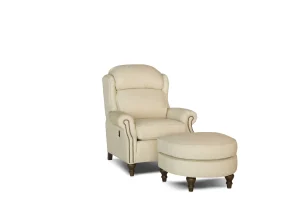 The tiltback is the most traditional of the types of recliners. Instead of a footrest popping out, the seat and back tilt back together as one unit, and you put your feet up on a matching ottoman. From across the room, a tiltback looks like a classic upholstered club chair, which makes it a natural fit for a formal living room or a study where a standard recliner might feel out of place. The ottoman pulls double duty too, since you can move it wherever you like or use it as extra seating when company comes. Just know that a tiltback offers a relaxed lean rather than a full stretch-out, so it’s better for reading than for napping. Smith Brothers Style 932 is a tiltback chair with a matching ottoman, both available in fabric or leather.
You’ll run into a couple of other types of recliners while you shop, too. Wall-hugger recliners, sometimes called wall-savers, slide the seat forward as they lean back, so they can sit just a few inches from the wall. Lift recliners use a motor to tilt the whole chair forward and help you stand up. Both solve specific problems, and they’re worth knowing about as you compare options.
So which types of recliners are most popular? Power recliners are out front. Industry analysts at Coherent Market Insights project that power recliners will make up about 65 percent of the global recliner market in 2026, and the same report puts leather as the most common cover material. Other research firms estimate power’s share closer to half, but every estimate we found puts it out front. That said, popular and right for you aren’t always the same thing.
Here’s a simple way to match the types of recliners to your home. If you want a clean, classic look with no cords, start with a pressback. If you want effortless control and every angle in between, go power. If the chair will live in a nursery or the middle of an open room, look at a swivel glider. And if you want a chair that blends into a formal space, a tiltback with an ottoman is a great fit.
Whichever direction you lean, pull out the tape measure before you fall in love with a chair. Skipping that step is one of the most common furniture buying mistakes we see. Measure the floor space in front of and behind the chair, and pay attention to seat height. Just like finding your ideal bed height, the right seat height makes sitting down and getting up noticeably easier. And if you run into unfamiliar terms while comparing construction, our guide to benchmade furniture and the industry terms that matter is a good place to start.
Dad’s chair had one job, and it did it well. Today’s recliners still do that same job. They just give you more ways to get there. Whether you press back, push a button, swivel toward the kitchen, or prop your feet up on an ottoman, the goal hasn’t changed since Dad cranked that handle: a comfortable place to land at the end of a long day. Now you know enough to find the one that fits the way you like to unwind.
Steve Payne is content writer at Millwest Amish Furniture in Plain City, Ohio. He writes about solid wood craftsmanship, furniture care, mattress selection, and the materials that make Amish-built furniture last for generations. With deep roots in Ohio’s furniture community and direct access to Millwest’s network of Amish craftsmen, Steve brings a practical, experience-driven perspective to every article.