
From the innerspring core to the quilted cover: The engineering details that determine whether your mattress lasts 7 years or 20
Introduction: Construction is Destiny
Here’s a truth the mattress industry doesn’t want you to know: How a mattress is built matters far more than what it’s called.
You can slap “luxury,” “premium,” or “orthopedic” on any mattress label. But you can’t fake the engineering that determines whether you’ll still be sleeping comfortably at year 15—or whether you’ll be back in a showroom with a sore back at year 6.
The difference between a mattress that lasts 7 years and one that lasts 20 years isn’t magic. It’s wire gauge. Foam density. Insulation layers. Lamination method. Edge support design.
These are the unglamorous, invisible details that manufacturers hope you won’t ask about. Because once you understand them, you can’t un-see the shortcuts in cheap mattresses.
This guide pulls back the cover—literally—on how a quality mattress is constructed. We’ll start at the core and build outward, layer by layer, explaining what each component does and why it matters.
What we’ll cover:
- Innerspring Systems – Wire gauge, coil types, and why thickness beats count
- Foam Cores – High-density polyurethane and natural latex alternatives
- Insulation Layers – The critical middle that prevents premature failure
- Foam Comfort Layers – Density vs. firmness (and why weight = longevity)
- Lamination – How layers bond together (and why most fail)
- Edge Support – Double-edge coil systems vs. foam rails
- Hand Assembly – Why craftsmanship matters
- Complete System – How it all works together
By the end, you’ll know more about mattress construction than 95% of salespeople.
PART 1: The Foundation – Innerspring Systems
The Wire Gauge Principle: Thickness Beats Count
Walk into any mattress store and you’ll hear: “This mattress has 1,000 coils!”
Here’s what they won’t tell you: That means nothing without knowing the wire gauge.
Wire gauge measures steel thickness. Counter-intuitively, lower numbers = thicker wire.
| Wire Gauge | Who Uses It | Relative Strength |
|---|---|---|
| 12.75-13 gauge | Monarch Rest, premium brands | ++++ Strong |
| 14 gauge | Mid-tier brands | +++ Moderate |
| 14.5 gauge | Big-box brands | ++ Weaker |
| 15 gauge | Budget brands | + Minimal |
Why this matters: A 12.75 gauge coil contains approximately 30% more steel than a 14.5 gauge coil. Over thousands of compression cycles (a decade of nightly use), that extra material prevents sagging and permanent deformation.
Monarch Rest uses 12.75-13 gauge wire across all innerspring lines. Most big-box brands use 14.5-15 gauge.
The Three Innerspring Types
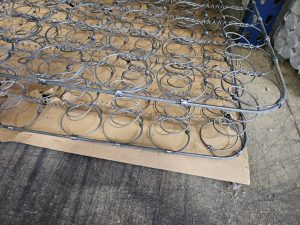
1. Traditional Bonnell Coils
Construction: Hourglass-shaped coils connected by spiral wires
Used in: Quiet Night series
Advantages:
- Cost-effective
- Proven technology
- Firm, traditional feel
- Good breathability
Disadvantages:
- Motion transfer (coils interconnected)
- Less body contouring
Best for: Budget-conscious solo sleepers who prefer traditional firm support
Monarch Rest advantage: Even in entry-level Quiet Night, they use 13 gauge wire vs. industry-standard 14.5-15 gauge.
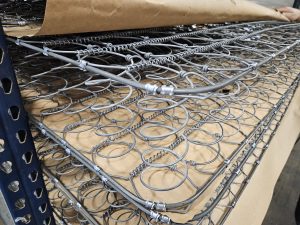
2. Offset Coils
Construction: Hourglass coils with hinged connections for flexibility
Used in: Elite series (two-sided gold standard)
Advantages:
- Better conforming than Bonnell coils
- Excellent durability for two-sided designs
- Maintains firmness while adding responsiveness
Disadvantages:
- More expensive than Bonnell
- Some motion transfer remains
Best for: Traditional spring lovers who want better contouring; ideal for two-sided mattresses
Why offset coils excel in two-sided designs: The hinged connection distributes weight evenly when flipping regularly. Traditional Bonnell coils can develop wear pa
tterns, but offset coils handle bi-directional use better.
3. Pocket Coils (Independent Suspension)
Construction: Individual coils wrapped in fabric pockets
Used in: Integrity series, Resilience series
Coil counts: 966-2,115 coils (depending on size)
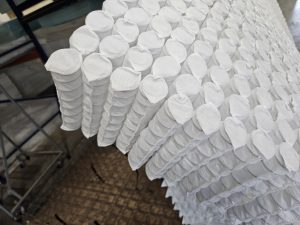
Advantages:
- Zero motion transfer – Each coil moves independently
- Superior body contouring
- Targeted support for different body zones
- Quietest innerspring design
- Longest lifespan
Disadvantages:
- Most expensive
- Requires expert construction
Best for: Couples, motion-sensitive sleepers, those with pressure point issues
From the facility tour: “Pocket coil systems are the best on the market today. The innerspring typically outlasts the padding.”
This is critical: In pocket coil mattresses, the springs aren’t the weak point—the foam layers are. This is why Monarch Rest pairs pocket coils with high-density foam.
Coil Count: When It Matters
Marketing claim: “More coils = better support!”
Engineering reality: More coils help IF wire gauge and coil type are equal.
Example:
- Mattress A: 1,000 pocket coils, 14.5 gauge
- Mattress B: 450 offset coils, 12.75 gauge
Mattress B wins because thicker wire provides stronger individual coils, and 450 properly-gauged coils is sufficient.
When higher coil count matters: In pocket coil systems using the same gauge wire, more coils = more precise contouring. Monarch Rest’s Integrity line has 1,620 pocket coils in a Queen for maximum precision.
For real-world performance comparisons: Monarch Rest vs. “The Other Guys”
PART 2: The Alternative – Foam Core Systems
Not everyone wants springs. Enter: high-density foam cores.
High-Density Polyurethane Core
Used in: Conforma series, Resilience Premier
Specifications: 2.4 wt. per cubic foot, 23-44 ILD (firmness)
Why high-density matters: A 2.4 wt. foam core lasts approximately twice as long as a 1.2 wt. core before developing impressions.
Ideal for:
- Adjustable base users (foam flexes; traditional springs don’t)
- Zero motion transfer needs
- Silent operation (no squeaking ever)
Natural Latex Core
Used in: Resilience Luxe (6-inch latex core)
Material: 100% natural Talalay latex from rubber tree sap
Why latex is special:
- Longest-lasting material – Outlasts all other mattress materials
- Naturally breathable (stays cool)
- Resilient (bounces back instantly)
- Hypoallergenic, antimicrobial
- Environmentally friendly
From the facility tour: “Natural latex is sourced from real rubber tree sap. Zero petroleum used. It’s the longest-lasting material available.”
Price reality: All-latex construction is expensive (latex costs 3-4x more than polyurethane), but cost-per-year over 20+ years makes it competitive.
PART 3: The Critical Middle – Insulation Layers
This is where most cheap mattresses fail, and most buyers have no idea why.
What Insulation Does
Between the innerspring/core and comfort layers, Monarch Rest includes:
- Resinated pad (rigid barrier)
- Polyester pad (cushioning)
- Protective mesh (barrier layer)
- Mid-section support pad (targeted reinforcement)
Why these exist: To prevent foam comfort layers from being pushed into spring coils over time.
What Happens Without Proper Insulation
Year 1-3: Mattress feels great.
Year 4-6: Foam compresses and pushes into coil gaps, causing:
- Foam damage (friction against metal)
- Pressure points (you feel the springs)
- Accelerated foam breakdown
Year 7-10: Permanent body impression. The foam has deformed into the coil structure.
This is how most “10-year warranty” mattresses fail at year 6-7—and warranty claims get denied because the springs are still functional.
Monarch Rest’s Multi-Layer Approach
Each layer has a specific job:
- Resinated pad – Rigid barrier between springs and softer layers
- Polyester pad – Cushioning that distributes weight
- Protective mesh – Additional barrier, prevents fiber migration
- Mid-section support pad – Targeted support in high-wear area (hips/torso)
The quality marker: Ask to see a cutaway model. Count the layers between springs and foam. More layers = better longevity.
Monarch Rest transparency: Every product diagram shows complete layer construction, including insulation—unusual in the industry.
PART 4: The Comfort Zone – Foam Layers
Density vs. Firmness: The Critical Distinction
This is the #1 misunderstanding in mattress shopping:
Firmness (ILD Rating) = How foam feels when you lie on it
- Measured in pounds of force to compress 4 inches
- Range: 15 ILD (very soft) to 50 ILD (very firm)
- This is immediate feel
Density (Weight Rating) = How much foam weighs per cubic foot
- Measured in pounds per cubic foot
- Range: 1.0 wt. (very light) to 5.0+ wt. (very heavy)
- This is longevity
You can have:
- Firm, low-density foam → Feels supportive initially, breaks down quickly
- Plush, high-density foam → Feels soft, maintains softness for decades
The Weight = Longevity Principle
From the facility tour: “The heavier the foam, the longer it will last.”
| Foam Density | Lifespan | Who Uses It |
|---|---|---|
| 1.2-1.5 wt. | 5-7 years | Big-box standard |
| 1.8 wt. | 10-15 years | Monarch Rest standard |
| 2.4 wt. | 15-20 years | Monarch Rest premium |
| 4.0+ lb. | 15-20+ years | Memory foam specialists |
Monarch Rest uses 1.8+ wt. foam as standard across ALL product lines—even budget Quiet Night uses 1.8 wt. quilting foam.
The Three Foam Types
1. Polyurethane Foam
- Specifications: 1.8-2.4 wt., 23-44 ILD
- Used in: All lines except pure latex models
- Advantages: Cost-effective, wide firmness range, proven durability
2. Gel-Infused Memory Foam
- Specifications: 4 lb. density, 2-3 inches thick
- Used in: Conforma Gel, Perfect Choice Gel, Integrity Premier
- Advantages: Superior pressure relief, cooler than standard memory foam
- Comparison: Tempur-Pedic uses 4-5 lb. memory foam; Monarch Rest uses 4 lb. at 40-50% less cost
3. Natural Talalay Latex
- Specifications: Density 55, 75, or 95 (higher = firmer)
- Used in: Elite Luxe, Conforma Latex, Perfect Choice Latex, Integrity Luxe, Resilience (all models)
- Advantages: Longest-lasting material, naturally breathable, hypoallergenic, eco-friendly
- Note: Costs 3-4x polyurethane but outlasts everything
From the facility tour: “Latex resilience is similar to silicone-based materials. Monarch’s Latex Luxe models are probably the most equivalent to Purple® brand mattresses—similar responsive bounce, but natural material vs. synthetic polymer grid.”
Need help choosing foam types for your sleep style? The Complete Buyer’s Guide: Matching Your Sleep Style to the Right Monarch Rest Mattress
PART 5: The Bond – Lamination
What holds all these layers together? Adhesive. And it matters more than you think.
Cheap Lamination vs. Quality Lamination
Cheap (spray-applied adhesive):
- Fast to apply
- Adequate for 5-7 years
- Can delaminate (layers separate) after that
Quality (water-based adhesive – Monarch Rest):
- Takes longer to apply
- More expensive
- Creates stronger bonds
- Prevents delamination over decades
From the facility tour: “Monarch uses water-based glue to bond each layer. Most manufacturers use cheaper, less durable adhesives. Water-based adhesive is more environmentally friendly and creates stronger, more durable bonds. This is NOT standard practice.”
What delamination looks like: By years 8-10, you feel “layers” when you move, lumpy spots develop, foam edges feel detached. The mattress is structurally compromised.
Why this matters: It’s invisible, but it’s the difference between 20 years of structural integrity versus falling apart at year 8.
PART 6: The Perimeter – Edge Support
Sit on the edge of your mattress. Do you feel like you’re sliding off? That’s failed edge support.
Why Edge Support Matters
- Usable sleep surface (poor edge support = 15-20% loss)
- Durability (edge collapse accelerates overall breakdown)
- Sitting support (getting in/out of bed)
The Three Systems
1. No Edge Support → Edge collapses within 2-3 years (ultra-budget brands)
2. Foam Rails → High-density foam blocks around perimeter (mid-tier)
- Better than nothing
- Compresses over time
- Can create “ridge” feel
3. Double-Edge Coil Side Supports → Reinforced border coils (Monarch Rest – premium)
- Strongest available
- Maintains integrity 20+ years
- No compression (steel doesn’t compress)
- Full sleep surface maintained
Used in: Elite, Perfect Choice, Integrity lines (12-14 supports per Queen/King)
From the knowledge base: “We build our beds with the strongest, most durable double-edge coil side supports we could find. We believe they provide the best edge support compared to other systems.”
PART 7: Hand-Crafted Assembly
How a mattress is assembled determines whether specifications result in quality.
Mass Production vs. Monarch Rest
Factory approach:
- Assembly line, hundreds per day
- Workers specialize in one step
- Quality control: spot-check random samples
- Goal: Maximum throughput
Monarch Rest approach:
- ~10-person team, Sugarcreek, Ohio
- ~3 craftspeople actively assembling at any time
- Each mattress built start-to-finish by same people
- 100% inspection
From the facility tour: “The hand tools used by experienced workers actually outpace the machines. This demonstrates high skill level and explains why hand-assembly produces superior quality.”
Why this matters:
- Accountability – Someone’s name is on every mattress
- Precision – Layers perfectly aligned (matters for comfort and durability)
- Flexibility – Custom orders are as easy as standard
- Quality control – Every mattress inspected, not sampling
The Custom Sizing Advantage
Mass production: Custom sizing disrupts assembly line, costs significantly more
Hand-assembly: Custom sizing is just as easy as standard
Monarch Rest capabilities:
- Any standard size
- Any custom dimension (antique beds, RVs, boats)
- Split firmness (different sides)
- Special heights
Example: Need a 52″ × 78″ mattress for an antique bed? Monarch Rest can build it using the same quality standards.
PART 8: The Complete System – How It All Works Together
Let’s see how these components work in a real mattress.
Example: Elite Plush (Queen) – 13″ Total Height
From bottom to top:
CORE:
- 12.75 gauge offset coil innerspring
- 450 coils
- 14 double-edge side supports
INSULATION (4 layers):
- Resinated pad → Protective mesh → Mid-section support pad → Polyester pad
COMFORT LAYERS:
- 2″ convoluted foam, 1.8 wt. (pressure relief, breathability)
- Water-based adhesive bond
- 1.25″ polyurethane foam, 1.8 wt. (comfort transition)
TOP COVER:
- 1.25″ quilted cover with 1.8 wt. quilting foam
- Rayon-polyester fire-retardant blend
BOTTOM SIDE (double-sided):
- Identical construction (1.25″ quilted cover + foam layers)
Assembly: Hand-crafted, water-based lamination throughout
Expected Lifespan: 20+ years with proper care (flip/rotate every 6 months)
Why This Combination Works
The 12.75 gauge offset coils provide foundational support—still functional at year 20.
The 4 insulation layers prevent foam from pushing into coil gaps.
The 1.8 wt. foam in all comfort layers maintains structure for 15+ years.
The convoluted design adds breathability without sacrificing support.
The double-sided construction means at year 10, flip it for a “new” sleeping surface.
The water-based lamination keeps layers bonded for decades.
The double-edge supports maintain full sleep surface for life.
The hand-assembly ensures perfect alignment.
No single component is a miracle. But together, engineered correctly and assembled with care, they create 20 years of quality sleep.
Construction Quick Reference
The Questions to Ask Any Mattress Salesperson
About the Core:
- “What gauge wire is the innerspring?” (13 or less is quality)
- “How many coils, and what type?” (Pocket, offset, or traditional?)
- “Or if foam: what’s the density in weight per cubic foot?” (1.8+ is good, 2.4+ is excellent)
About Comfort Layers: 4. “What’s the foam density for each layer?” (Density = lifespan, not firmness) 5. “Is the foam CertiPUR-US certified?” (Low VOCs, no harmful chemicals)
About Construction: 6. “How many insulation layers between springs and foam?” (4+ is quality) 7. “What adhesive bonds the layers?” (Water-based is premium) 8. “What type of edge support?” (Double-edge coil > foam rail > none)
If they can’t answer, you’re buying blind.
Conclusion: Why Construction Determines Everything
The difference between a mattress that fails at year 7 and one that’s comfortable at year 20 isn’t magic. It’s:
✓ Wire gauge: 12.75g vs. 14.5g
✓ Foam density: 1.8 wt. vs. 1.2 wt.
✓ Insulation: 4 layers vs. 1 layer
✓ Lamination: Water-based vs. spray glue
✓ Edge support: Double-edge coils vs. foam
✓ Assembly: Hand-crafted vs. automated
These aren’t marketing claims. They’re engineering realities.
Heavier wire lasts longer.
Denser foam resists impressions longer.
Proper insulation prevents layer degradation.
Water-based lamination holds stronger bonds.
Hand-assembly enables quality control.
Monarch Rest’s approach: Use better materials, don’t cut corners, assemble by hand, stand behind it for 20 years.
It’s not complicated. It’s just honest engineering.
Next Steps
Now that you understand construction:
- Match construction to your sleep needs → The Complete Buyer’s Guide: Matching Your Sleep Style to the Right Monarch Rest Mattress
- Compare vs. competitors → Monarch Rest vs Other Brands: What Mattress Stores Hide
- Understand warranty coverage → Understanding Mattress Warranties: Why 20 Years Actually Matters
Armed with this knowledge, you’re ready to shop like an engineer instead of a consumer.
Steve Payne is content writer at Millwest Amish Furniture in Plain City, Ohio. He writes about solid wood craftsmanship, furniture care, mattress selection, and the materials that make Amish-built furniture last for generations. With deep roots in Ohio’s furniture community and direct access to Millwest’s network of Amish craftsmen, Steve brings a practical, experience-driven perspective to every article.