Picture it: You’re at the counter cooking dinner. Your 4 year old is at the table with their crayons and a piece of paper, and as you have your back turned, they decide a pen is actually the tool they need for the job they’re doing. While you’re peeling potatoes, they go for the pen in your purse that they know is always there. By the time you dump the peels in the trash, they’ve already come back and you’re none the wiser. As you’re chopping carrots, they’re dotting their paper with an ink pen. Only it’s more like jabs and stabs, but you don’t realize it at first because the sound of their jabbing sounds just like your knife hitting the cutting board. But as you stop chopping…the sound keeps going. You spin to see their determined expression, their little fist white-knuckling the pen and the blur of their fist going up and down as they jab at the table. By the time you get to them the table is dented, scratched, and in your mind…ruined.
Why was the pen mightier than the table?
If you’ve ever shopped for solid wood furniture and found yourself reading terms like “1450 lbf” or “Janka rating,” you’re not alone. Most people gloss right over it. And honestly, that’s understandable. It sounds like something you’d need an engineering degree to care about. But here’s the thing: the Janka hardness scale is actually one of the most practical tools for understanding whether a piece of furniture is going to hold up to your family’s real life for the long haul. Once you understand what it’s actually measuring, it changes how you look at wood furniture entirely.
What Is the Janka Hardness Scale?
The Janka hardness scale is a standardized measurement system used to rate the hardness and durability of wood species. It’s named after Gabriel Janka, an Austrian-born wood researcher who developed the test in the early 1900s. The test was later standardized through the American Society for Testing and Materials, and it remains the industry standard today.
Here’s how it works. A steel ball measuring exactly 0.444 inches in diameter is pressed with increasing force into a sample of wood. The test measures how many pounds of force it takes to embed that ball exactly halfway through. That number, expressed in pounds-force (lbf), becomes the wood’s Janka rating. The higher the number, the harder the wood.
Why Janka Ratings Can Vary From Source to Source
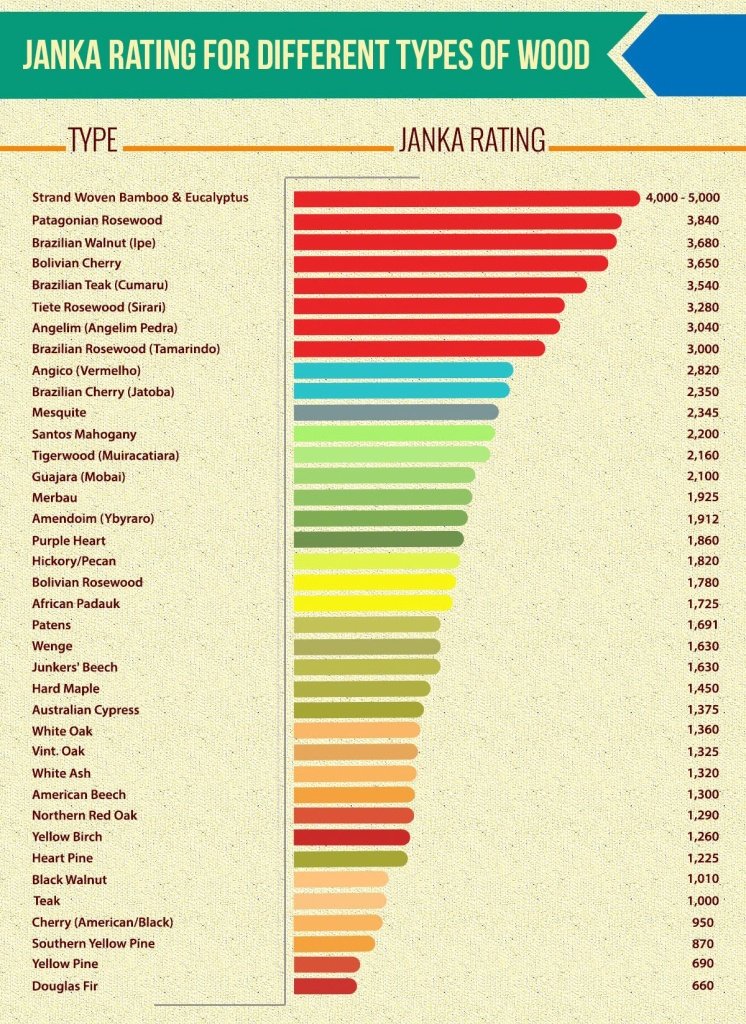
If you’ve done any research on wood hardness and noticed that different charts list different numbers for the same species, you’re not imagining things. Red Oak, for example, appears anywhere from 1,220 to 1,290 lbf depending on where you look, even across respected industry resources like the Wood Database. That’s not a mistake on anyone’s part. It’s actually a reflection of how the test works in the real world.
A few factors drive that variation. First, the Janka rating for any species is an average across multiple wood samples, not a single definitive measurement. Every tree grows differently based on soil conditions, climate, elevation, and age, and those differences show up in the numbers. Two red oak trees from different forests will produce slightly different test results, and published ratings reflect that range of natural variation.
Moisture content also plays a significant role. The standard Janka test is conducted at 12% moisture content, but not every source tests under identical conditions. Drier wood tests harder, and even small differences in moisture at the time of testing can shift the result meaningfully.
Finally, there’s a distinction between side hardness and end hardness. Testing the face of a board produces a different result than testing a cut end of the same piece. Most furniture and flooring industry ratings use side hardness, but the methodology isn’t always consistent across sources.
What this means practically is that a difference of 50 to 100 lbf between two published ratings for the same species is well within the normal range. The relative ranking of species stays consistent even when the exact numbers shift slightly. Hickory is always harder than Oak, Oak is always harder than Cherry, and that hierarchy is what actually matters when you’re choosing furniture for your home. The specific number is a useful reference point, not a precise specification.
Why the Janka Hardness Scale Matters for Furniture
The Janka scale is most commonly associated with flooring, and it’s true that flooring takes a beating. But the same logic applies to furniture, especially pieces that see daily use. A dining table where kids do homework and apparently attempt to stab through the surface with ballpoint pens. A bedroom dresser that gets bumped and dragged. A coffee table that’s lived in with feet up and drinks set down without coasters. All of these situations put real stress on wood, and harder woods simply hold up better over time.
That said, hardness isn’t everything. It’s one important factor alongside grain pattern, staining properties, workability, and aesthetics. Understanding the Janka scale helps you make a more informed decision when you’re weighing your options, not make the decision for you entirely.
A good rule of thumb in the furniture world is that woods with a Janka rating of 1,000 lbf and above are strong candidates for high-use pieces. Woods below that threshold aren’t necessarily fragile, but they may require a bit more care in the right situations.
How Our Wood Species Stack Up on the Janka Scale
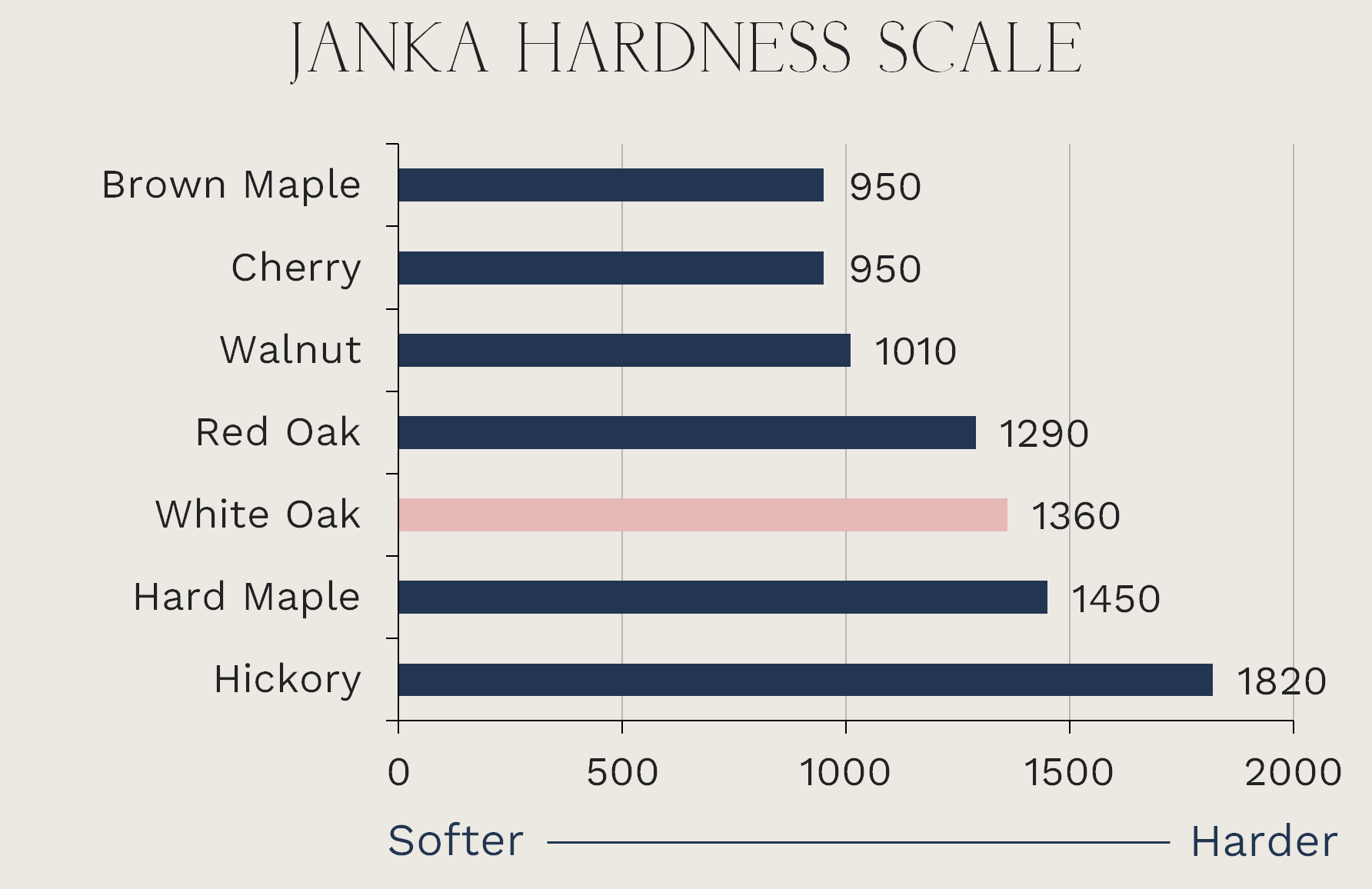
At Millwest, we carry a range of hardwood species across our furniture collections. Here’s how they rank on the Janka hardness scale, from most durable to most refined.
Hickory: 1,820 lbf
Hickory sits at the top of the Janka scale among the woods commonly used in Amish furniture making. At 1,820 lbf, it’s the hardest option available in most of our collections. That density makes it exceptionally resistant to denting and wear, and it’s a natural fit for families who want furniture built to last through decades of real use (and yes, determined toddlers with writing utensils). The tradeoff is that Hickory’s bold, dramatic grain pattern isn’t for everyone. It has character in abundance, knots and all, and it tends to look best in rustic or traditional settings. If you’re drawn to furniture that tells a story, Hickory is hard to beat.
Hard Maple: 1,450 lbf
Hard Maple, also called Clear Maple, checks in at 1,450 lbf. It’s the second hardest option in most of our collections and one of the most versatile woods available. Its subtle, consistent grain pattern makes it a favorite for contemporary and Shaker-style furniture, and it accepts a wide range of stain finishes beautifully. For families who want durability without the visual boldness of Hickory, Hard Maple is often the sweet spot.
Quarter Sawn White Oak (QSWO): 1,360 lbf
Quarter Sawn White Oak lands at 1,360 lbf, placing it comfortably in the upper range of hardness for furniture applications. What makes QSWO distinct isn’t just its hardness, though. The way the wood is milled at a perpendicular angle to the growth rings creates a tighter, more stable grain structure with a distinctive ray fleck pattern. It’s one of the most dimensionally stable woods available, meaning it’s less prone to warping or swelling with humidity changes. Our wood characteristics guide goes deeper into what makes QSWO unique if you want to explore further.
Red Oak: 1,220 lbf
Red Oak is a familiar name for a reason. At around 1,220 lbf, it’s been an industry benchmark for wood hardness comparisons for decades. It’s reliable, widely available, and takes stain consistently well. The deep, open grain pattern that Red Oak is known for gives it a classic, traditional look that pairs well with a wide variety of home styles. If you’re exploring dining room furniture and aren’t sure where to start with wood species, our post on choosing the best wood for your dining room table walks through how each species plays a different role.
Cherry and Brown Maple: 950 lbf
Cherry and Brown Maple both land at approximately 950 lbf on the Janka scale, making them the softer end of what we carry. Softer is relative, of course. At 950 lbf, both are still genuine American hardwoods that hold up well under normal use. But for households with young children, pets, or furniture that’s going to take consistent daily wear, it’s worth having a conversation about whether an upgrade to a harder species makes sense.
Where Cherry truly earns its reputation is in its appearance. Few woods age as gracefully. Cherry starts with a lighter, warm tone and deepens into a rich reddish-brown over time with natural light exposure. It’s one of the most beautiful woods available for fine furniture, and many buyers choose it specifically because they want that patina to develop over the years.
Brown Maple, meanwhile, offers a smooth and subtle grain with a more consistent appearance than most woods. It tends to look best in medium to dark stain finishes, which help mask the natural mineral streaking that can show through in lighter tones.
What the Janka Scale Doesn’t Tell You
It’s worth being clear about the limits of the Janka scale, because it’s easy to assume harder automatically means better. That’s not quite right.
Harder woods are also more difficult to machine, nail, and saw, which is why craftsmanship matters so much when working with species like Hickory or Hard Maple. The skill of the furniture maker plays a significant role in how well those properties translate into a finished piece. That’s one of the reasons the Amish furniture tradition has always valued experienced, specialized craftspeople who know their materials deeply. You can read more about what makes handcrafted wood furniture different in our introduction to wood fundamentals.
Beyond hardness, factors like how a wood responds to staining, how it handles changes in humidity, and how its grain pattern suits your space all matter just as much when you’re making a purchase decision. Janka ratings are a starting point, not the whole story.
Matching Hardness to Your Lifestyle
The practical question most people should be asking isn’t “which wood is hardest?” but rather “what level of hardness does my lifestyle actually require?”
If you have young children, pets, or a dining room that doubles as a homework station and craft table (and occasional pen-stabbing arena), a Janka rating of 1,200 lbf or higher gives you a meaningful durability advantage. Pieces like our Arlington Dining Collection, Liberty Dining Collection, and Shaker Dining Collection are all available in harder species like Oak, Hard Maple, and Hickory, giving you flexibility to match the right material to the right need.
For bedroom furniture, where pieces typically see less daily wear, a wood like Cherry or Brown Maple can be a genuinely excellent choice. The Timbermill Collection is a great example of how a well-crafted piece in a softer hardwood can still be built to last. The Janka rating matters less in a context where the furniture isn’t taking heavy daily use.
A Helpful Reference Frame
To put the scale in perspective, here’s how the woods in our collections compare to a few reference points most people have some familiarity with. Balsa wood, the stuff used in model airplanes, has a Janka rating of around 70 lbf. White pine, which shows up in a lot of budget furniture, typically sits around 380 to 420 lbf. Standard construction-grade pine lands around 600 lbf. The woods we carry start at 950 lbf and go up from there, which puts them in a genuinely different category of durability than a lot of what you’ll find at big-box furniture stores.
The Bottom Line
The Janka hardness scale is a genuinely useful tool once you know how to use it. It’s not a perfect predictor of how furniture will perform in every situation, but it gives you a real, objective measure to compare species and make smarter choices for your home. Understanding where each wood falls on the scale, and what that means practically for your lifestyle, takes a lot of the guesswork out of an already complicated buying decision.
If you’re not sure which wood species fits your needs, we’re happy to talk it through. Every household is different, and the right choice depends on more than a number.
Be sure to explore the customization options on our online catalogue of furniture to find what stain and hardware is best for your furniture! Stain and hardware options vary by furniture piece and wood type. Some stains work better on certain woods, and hardware options may vary by collection.
Browse our dining room collections to find a piece built for the way you actually live, in the wood species that’s right for you.